
High-carbon chromium bearing steel delivered soft enough to cold-form and hard enough to outlast the assembly. GCr15 carries 0.95–1.05% C and 1.30–1.65% Cr, reaching HRC 60–65 after quenching — the working range for bearing rollers, steel balls and rolling-contact components.
Bearing steel is defined by what rolling contact demands: high hardness, uniform carbide distribution and fatigue life measured in billions of revolutions. Chromium makes all three possible.
The base grade: GCr15 / 100Cr6 / SUJ2. These three names describe essentially the same material — roughly 1.0% carbon and 1.5% chromium — certified under three standards. GCr15 carries 0.95–1.05% carbon and 1.30–1.65% chromium, and after oil quenching from 830–860 °C plus tempering at 150–180 °C it reaches HRC 60–65.
The high-temperature variant: GCr18MoV. When the bearing runs hot — engine accessories, turbine gearboxes, hot-rolling mill neck bearings — plain GCr15 loses hardness above ~150 °C. GCr18MoV raises chromium to 1.65–1.95% and adds molybdenum (0.20–0.40%) and vanadium (0.10–0.20%), improving tempering resistance so the steel stays above HRC 58 at operating temperatures near 250 °C.
Beyond bearings. The same chemistry is used for precision shafts, gauge pins, bushings and die buttons — any component needing high hardness, wear resistance and dimensional stability through heat treatment. Bearing-grade certification costs more than plain tool steel, so if your part is not a rolling-contact component, the tool steel strip family may be the economic route — the chemistry overlaps, but the certification does not.
Most specification errors on this family are made at the standard boundary and the temperature boundary, not in the chemistry.
Near-identical chemistry, but the drawing specifies one standard and the MTC must match it. If your customer audits to GB/T 18254, buy GCr15; EN ISO 683-17 → 100Cr6; JIS G4805 → SUJ2.
Match the standard on the drawing, not the chemistry in the catalogue.GCr15 and SK5 overlap in carbon, but bearing steel carries chromium for hardenability and is certified to inclusion and fatigue standards. For precision shafts, gauge pins or wear pads, tool steel is cheaper and sufficient.
Choose bearing steel when contact fatigue life is the failure mode.GCr15 is rated for continuous operation up to ~150 °C. Above that, tempered martensite over-ages and hardness drops.
Choose GCr18MoV when operating temperature exceeds 150 °C.Indicative values per GB/T 18254, EN ISO 683-17 and JIS G4805 — confirmed on the MTC.
| Grade | C % | Si % | Mn % | Cr % | Mo % | V % | P % | S % |
|---|---|---|---|---|---|---|---|---|
| GCr15 | 0.95–1.05 | 0.15–0.35 | 0.20–0.40 | 1.30–1.65 | ≤0.10 | — | ≤0.027 | ≤0.020 |
| GCr18MoV | 0.95–1.05 | 0.15–0.35 | 0.20–0.40 | 1.65–1.95 | 0.20–0.40 | 0.10–0.20 | ≤0.027 | ≤0.020 |
| 100Cr6 | 0.93–1.05 | 0.15–0.35 | 0.25–0.45 | 1.35–1.65 | ≤0.10 | — | ≤0.025 | ≤0.015 |
| SUJ2 | 0.95–1.10 | 0.15–0.35 | ≤0.50 | 1.30–1.60 | ≤0.08 | — | ≤0.025 | ≤0.025 |
Final chemistry on the MTC per heat.
We ship spheroidized; you quench and temper. Both bands are documented — the as-delivered value on the MTC, the heat-treated value as a target range.
| Grade | As-delivered (spheroidized) HB | Quenched & tempered HRC | Quench / temper | Max operating temp. |
|---|---|---|---|---|
| GCr15 | 179–229 | 60–65 | Oil quench 830–860 °C / temper 150–180 °C | ~150 °C |
| GCr18MoV | 179–229 | 60–64 | Oil quench 840–870 °C / temper 180–250 °C | ~250 °C |
| 100Cr6 | 179–229 | 60–66 | Oil quench 820–860 °C / temper 150–180 °C | ~150 °C |
| SUJ2 | 179–229 | 58–64 | Oil quench 820–850 °C / temper 150–180 °C | ~150 °C |
Hardness values are typical / indicative and depend on section size, quenchant agitation and tempering temperature.
Equivalents approximate; confirm against your standard.
| GB (China) | EN (W-Nr.) | JIS | AISI / SAE | Notes |
|---|---|---|---|---|
| GCr15 | 100Cr6 (1.3505) | SUJ2 | 52100 | The standard high-carbon chromium bearing steel — near-universal interchange |
| GCr18MoV | — (100CrMoV5-1 approx.) | — (SUJ3-type approx.) | — (52100 mod.) | High-temperature bearing steel with Mo + V; no exact one-to-one cross-standard equivalent |
| — | 100Cr6 (1.3505) | SUJ2 | 52100 | EN path for the same base chemistry; certified to EN ISO 683-17 |
| — | 100Cr6 (1.3505) | SUJ2 | 52100 | JIS path for the same base chemistry; certified to JIS G4805 |
GCr15, 100Cr6, SUJ2 and AISI 52100 are the same material family under different standards — the choice is governed by your drawing's specified standard and audit requirements.
Where certification shows up in fatigue life.
The test: 2.0–8.0 mm GCr15 cold-formed or ground into roller blanks, quenched to HRC 60–64, precision ground. Must survive billions of contact cycles without spalling.
The test: GCr15 or 100Cr6 cold-headed into balls, quenched to HRC 60–66, lapped to sub-micron sphericity. Surface defects below 10 µm become fatigue initiation sites.
The test: 0.8–3.0 mm GCr15 blanked into thrust washers or drawn into needle cups, hardened to HRC 60–63. Thin sections demand uniform hardenability. See our clutch disc spring application.
The test: 3.0–10 mm GCr18MoV operating at 180–250 °C in rolling mills, turbine gearboxes or engine accessory drives. Plain GCr15 would soften.
All in-house in Shanghai — one contract, one MTC, one contact.
Full-cycle soft annealing produces uniform spheroidal carbides for fatigue life. See the spheroidizing guide.
Multi-pass rolling to your gauge with controlled surface and decarb — critical for ground rolling surfaces. See the surface defects guide.
Coils slit to your component width or leveled and cut to sheet — burr, camber and width tolerance managed and documented.
Gauge, surface, hardness, inclusion rating and decarb checks per coil; Mill Test Certificate with chemistry and processing history issued before export.
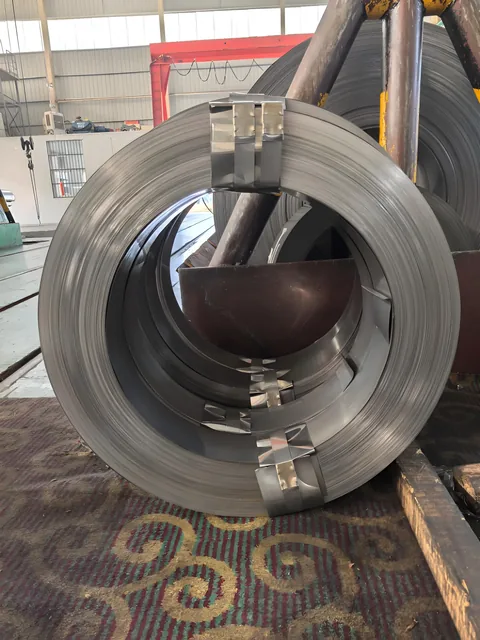
SK2–SK120, SKS51 and 95Cr15 for cutting edges — overlapping high-carbon chemistry but certified to tool steel standards.
Browse tool steel strip →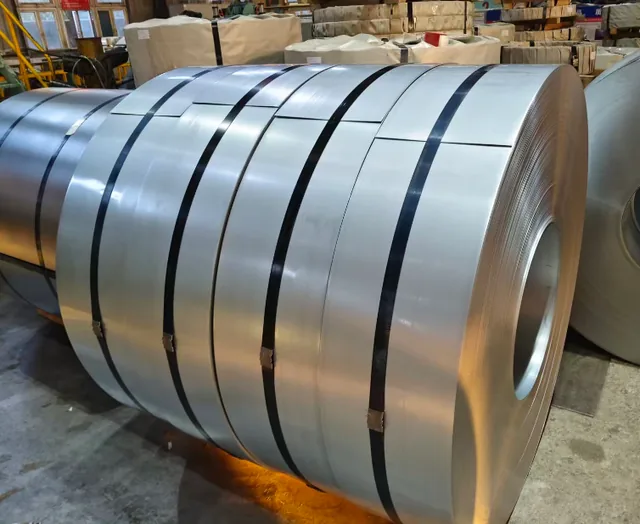
SAE1078 and C75S for springs and blade bodies — the economic high-carbon route when chromium and bearing certification are not required.
Browse high carbon strip →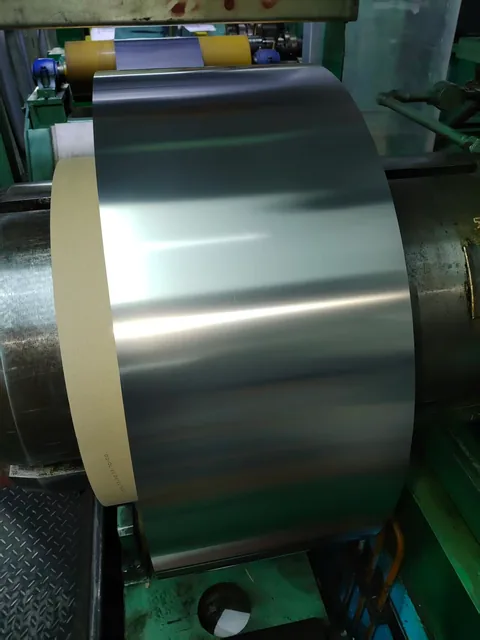
Bearing-quality wire rod and alloy structural bar — the round-bar counterpart when your bearing component is headed or drawn rather than rolled from strip.
Browse wire rod steel →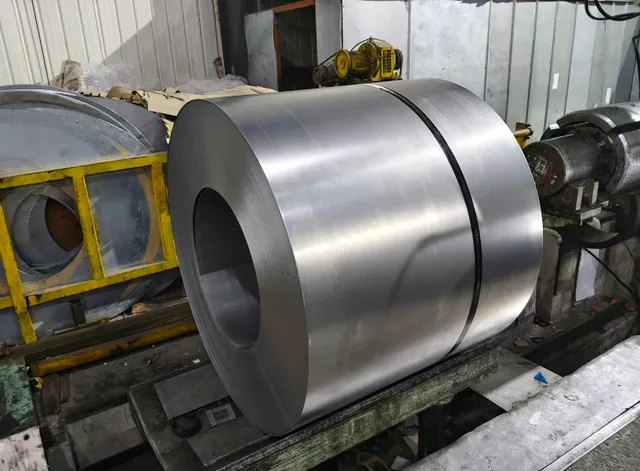
Medium carbon strip spheroidized for net-shape blanking of structural parts.
Browse fine blanking steel →Include grade, gauge, tonnage and destination.