
Strip that stores energy and gives it back — 50CrV4 vanadium alloy, 51CrV4 high-strength, 60Si2MnA silicon spring, C67S/C75S plain carbon and 65Mn manganese spring. Q&T to HRC 40–50, fatigue life above 1 million cycles.
Chromium-vanadium (50CrV4, 51CrV4). Vanadium forms fine stable carbides that resist grain growth at tempering up to 500°C — the spring retains hardness at engine-bay temperatures. 50CrV4 reaches ≥1250 MPa after Q&T and is standard for valve springs, clutch discs and diaphragm springs — specified when fatigue life above 1 million cycles is required. 51CrV4 at ≥1500 MPa. Silicon-manganese (60Si2MnA) pushes tensile to ≥1570 MPa with the highest elastic limit — for heavy-load flat springs, at the cost of toughness. Plain carbon (C67S, C75S) is economic entry point — hardens well under ~3 mm but lacks Cr/V for fatigue. 65Mn bridges plain carbon and alloy. The numbers: 50CrV4 ≥1250 MPa, 60Si2MnA ≥1570 MPa, C75S 0.05–6.0 mm, price band CNY 4,120–5,600/t. Most strip is supplied spheroidized for blanking before customer Q&T; H&T strip is for simple flat springs.
50CrV4 is the fatigue grade — Cr-V resists temper softening and delays crack initiation under cyclic load, for valve springs and clutch discs >100k cycles. 60Si2MnA is the strength grade — high Si pushes elastic limit above 1570 MPa but at lower toughness, for heavy-load flat springs. Cycles → 50CrV4; static high stress → 60Si2MnA.
C67S/C75S are cheaper and harden well in thin sections, but lack Cr/V for fatigue, elevated-temp stability and deep hardening. Boundary: under 3 mm, under 120°C, under 100k cycles — plain carbon is economic. Above any threshold, alloy premium pays See high carbon strip.
Spheroidized strip is soft (HRB 80–90) and formed/blanked before customer hardens — standard for complex geometries. H&T strip arrives at HRC 40–50 and is sheared to final shape — standard for simple flat springs, shims and washers. Wrong condition is the most common cause of spring cracking during forming.
Typical / indicative — confirmed on the MTC.
| Element | 50CrV4 | 51CrV4 | 60Si2MnA | C67S | C75S | 65Mn |
|---|---|---|---|---|---|---|
| C % | 0.47–0.55 | 0.47–0.55 | 0.56–0.64 | 0.65–0.72 | 0.70–0.80 | 0.62–0.70 |
| Mn % | 0.70–1.10 | 0.70–1.10 | 0.60–0.90 | 0.50–0.80 | 0.60–0.90 | 0.90–1.20 |
| Si % | ≤0.40 | ≤0.40 | 1.50–2.00 | 0.15–0.35 | 0.15–0.35 | 0.17–0.37 |
| Cr % | 0.90–1.20 | 0.90–1.20 | ≤0.35 | ≤0.30 | ≤0.30 | ≤0.25 |
| V % | 0.10–0.25 | 0.10–0.25 | — | — | — | — |
| P % | ≤0.030 | ≤0.030 | ≤0.035 | ≤0.030 | ≤0.030 | ≤0.035 |
| S % | ≤0.030 | ≤0.030 | ≤0.035 | ≤0.030 | ≤0.030 | ≤0.035 |
51CrV4 chemistry overlaps with 50CrV4; distinction is in guaranteed mechanical property band (51CrV4 ≥1500 MPa vs. 50CrV4 ≥1250 MPa). Typical/indicative, confirm at RFQ.
Typical / indicative — confirmed per coil on the MTC.
| Grade | Condition | Tensile (MPa) | Yield (MPa) | Elong. (%) | Hardness | Typical spring type |
|---|---|---|---|---|---|---|
| 50CrV4 | Q&T | ≥1,250 | ≥1,100 | ≥8 | HRC 40–48 | Valve springs, clutch discs, diaphragm |
| 51CrV4 | Q&T | ≥1,500 | ≥1,300 | ≥7 | HRC 45–50 | Heavy diaphragm, high-stress flat springs |
| 60Si2MnA | Q&T | ≥1,570 | ≥1,370 | ≥6 | HRC 45–50 | Die springs, suspension flat springs |
| C75S | Q&T | 1,200–1,600 | ≥1,000 | ≥7 | HRC 42–50 | Flat springs, washers, shims |
| C67S | Q&T | 1,000–1,400 | ≥800 | ≥8 | HRC 38–46 | Light flat springs, contacts |
| 65Mn | Q&T | ≥980 | ≥785 | ≥8 | HRC 42–48 | Flat springs, clutch parts, washers |
Fatigue life above 1M cycles achievable for 50CrV4/51CrV4 with proper surface finish, controlled decarb (≤1.5% thickness per side) and shot peening — specified at RFQ. Spheroidized hardness HRB 80–92. Typical/indicative, confirm at RFQ.
Substitution must be confirmed against your governing standard — approximate equivalent, not a certification.
| EN (European) | ASTM / SAE | GB (China) | JIS (Japanese) | Notes |
|---|---|---|---|---|
| 50CrV4 | 6150 | 50CrVA | SUP10 | Cr-V spring standard; highly interchangeable |
| 51CrV4 | 6150 (high str., approx.) | 50CrVA (high str., approx.) | SUP10 (high str., approx.) | Higher guaranteed tensile; verify property band |
| — (no direct EN) | 9260 (approx.) | 60Si2MnA | SUP7 (approx.) | Si-Mn high-elastic spring; decarb-sensitive |
| C67S | SAE1065 | 65# | SK7 (approx.) | Plain carbon spring; thin-section use |
| C75S | SAE1074 / 1078 | 75# | SK5 (approx.) | Plain carbon spring; widest gauge range |
| — (no direct EN) | SAE1566 (approx.) | 65Mn | — | Mn-alloyed spring; deep hardening |
60Si2MnA's high silicon content has no direct equivalent in EN spring steel grades. Final grade selection confirmed from your drawing and heat treat route.
The test: 51CrV4 or 50CrV4 blanked spheroidized, formed conical, then Q&T to HRC 45–50 — cycled millions of times in a clutch. Our answer: controlled-decarb strip (≤1.5% per side), ground/polished option. See clutch disc spring.
The test: 50CrV4 Q&T to HRC 44–48, coiled into a valve spring cycling at 3,000–6,000 rpm — V carbides resist softening at 120–150°C. Our answer: 50CrV4 with polished surface, verified decarb.
The test: C75S or C67S H&T to HRC 42–48, sheared to final shape — maintain contact force through thousands of deflections. Thin gauge means decarb is a larger fraction of thickness. Our answer: C75S at 0.05–6.0 mm, H&T with documented hardness
The test: 60Si2MnA Q&T to HRC 45–50, used as die spring or heavy-load washer under high compressive load — high Si pushes elastic limit above 1370 MPa, but not for high-cycle fatigue. Our answer: 60Si2MnA at CNY 4,460/t, supplied spheroidized for blanking before customer Q&T
Multi-pass rolling to your gauge tolerance with controlled surface finish.
Full-cycle soft annealing for blanking feedstock with controlled atmosphere to minimize decarb. See the spheroidizing guide.
Coils slit to narrow widths with burr and camber managed — burr on spring edges is a fatigue crack initiator.
Gauge, surface, hardness and decarb checks per coil; MTC issued before export. Learn to read one in the MTC guide.
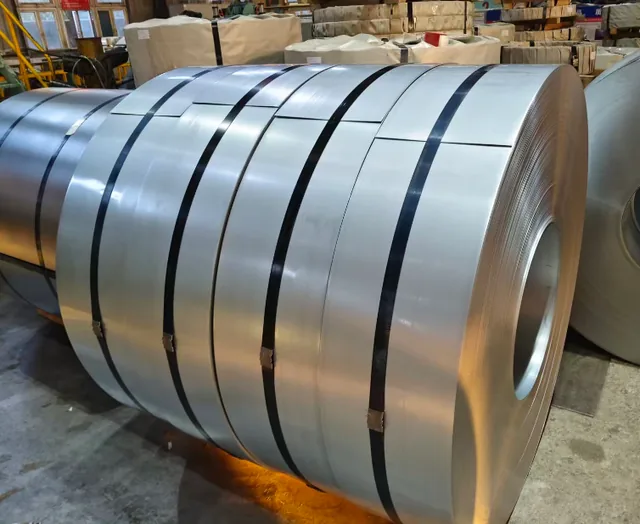
SAE1065–1078, SK5/SK7 and 65Mn — the plain-carbon view of C67S/C75S for blades and thin springs.
Browse high carbon →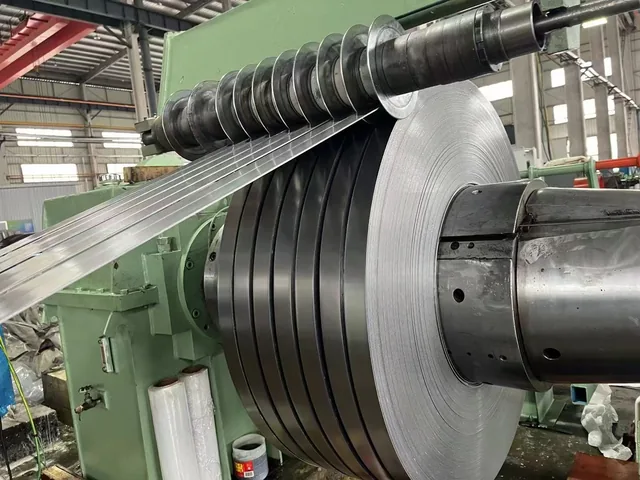
42CrMo, 20CrMnTi and 16MnCr5 — the structural view of 50CrV4 for gears, shafts and bolts.
Browse alloy structural →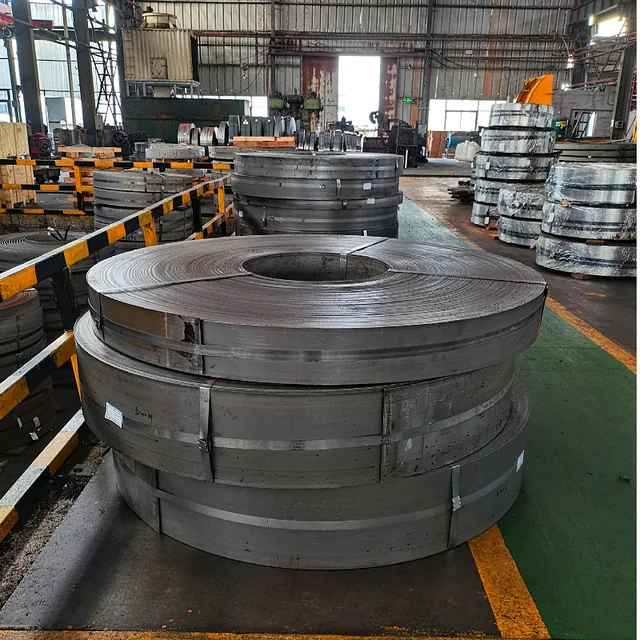
S10C–S55C and C45E–C60E for shafts, gears and fasteners when spring properties aren't required.
Browse medium carbon →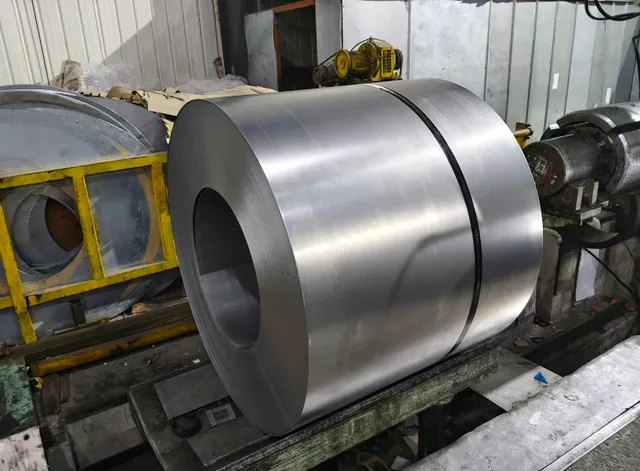
Spring and carbon grades in spheroidized condition for clean shear faces on precision-blanked parts.
Browse fine blanking →Include grade, thickness × width, tonnage, delivery condition, surface finish and decarb requirement. Engineers reply within one working day.